

A component that passed every incoming check can still fail at reflow if it has been sitting in humid air. Plastic packages absorb moisture, and when the board hits reflow temperature that trapped water turns to steam. The result can be cracked packages and internal delamination that may not show up until the product is in the field. Moisture sensitive components are the parts that need controlled storage and handling to avoid this. Here is how the moisture sensitivity levels work and how to handle these parts on the line.
What Are Moisture Sensitive Components?
Many surface mount packages, including BGAs, QFNs, QFPs and some plastic-moulded ICs, are made of materials that slowly absorb moisture from the air. Lead-free reflow peaks at higher temperatures than leaded processes, which makes the problem more severe. Water vapour expands quickly when heated, and the pressure can crack the package or separate internal layers. This failure is often called popcorning.
The damage is not always visible. A part may pass visual inspection and electrical test, then fail early because of an internal crack or a lifted bond. That is why handling rules matter more than inspection after the fact.
Moisture Sensitivity Levels (MSL) Explained
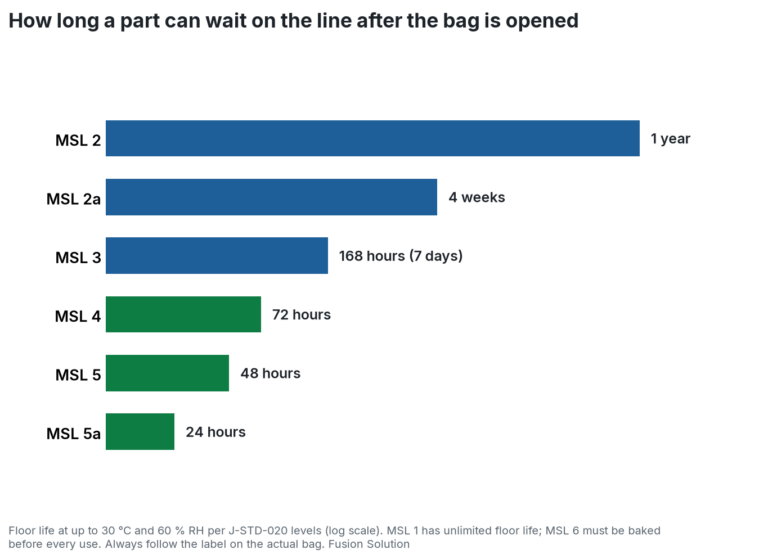
The industry rates each part with a moisture sensitivity level, set out in IPC/JEDEC J-STD-020. The level tells you how long the part may be exposed to factory air after its sealed bag is opened. This allowed time is called the floor life.
- MSL 1. Unlimited floor life at up to 30 °C and 85 % relative humidity. No special handling.
- MSL 2 and 2a. One year and four weeks of floor life respectively at up to 30 °C and 60 % relative humidity.
- MSL 3. 168 hours (seven days). One of the most common levels for BGAs and fine-pitch ICs.
- MSL 4, 5 and 5a. 72, 48 and 24 hours. These leave little time between opening the bag and reflow.
- MSL 6. The part must be baked before use, and then reflowed within the time on the label.
The chart above shows how quickly the available time shrinks as the level rises. Always read the label on the bag, because it states the level and the floor life for that specific part.
How to Handle Moisture Sensitive Components
Good handling is mostly discipline and records:
- Keep the bag sealed until needed. The moisture barrier bag, desiccant and humidity indicator card exist to protect the parts in transit and storage.
- Check the humidity indicator card. If the card shows the parts have taken on moisture beyond the limit on the card, bake them before use.
- Start the clock when the bag opens. Log the time and track floor life for every open reel, tray or tube.
- Return unused parts to dry storage. Reseal in a dry bag or keep them in a dry cabinet. Follow the storage guidance in J-STD-033 for how this affects the remaining floor life.
- Bake when the limit is exceeded. J-STD-033 gives bake temperatures and durations based on package thickness and moisture level. Tape and reel packaging often cannot take the highest bake temperatures, so check what the carrier allows.
- Do not bake repeatedly. Extra heat cycles can affect solderability and the parts themselves, so plan builds to avoid it.
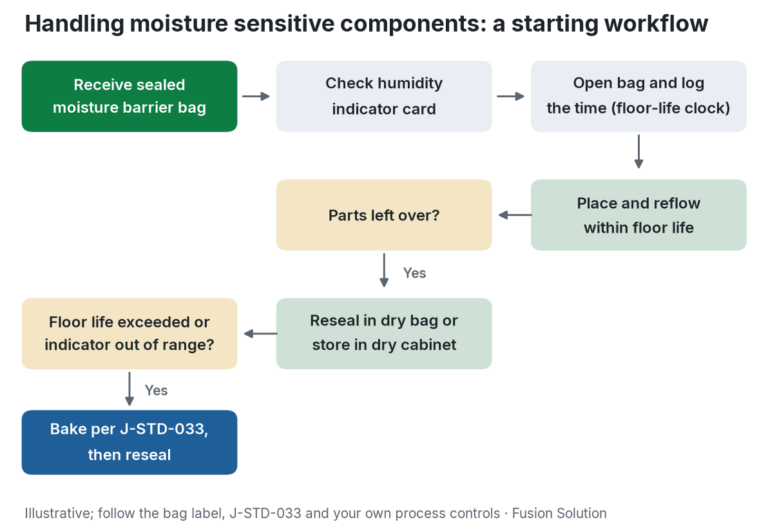
The workflow above is a starting point. Your own process controls, and the instructions from the component manufacturer, always take priority.
Moisture, Reflow and the Rest of the Process
Moisture control ties directly into the thermal side of assembly. A profile that is gentle on the board can still be harsh on a damp package, which is why it helps to understand perfecting the heat curve. Solder paste also absorbs moisture and has its own handling rules, as covered in our post on solder paste types. Planning these together reduces the chance of hidden defects.
Our Moisture Sensitive Components Approach at Fusion Solution
At Fusion Solution we treat moisture control as part of build planning, not an afterthought on the line. We check the moisture sensitivity level of the parts on the bill of materials, plan kitting and line scheduling around floor life, and keep opened parts in controlled storage. This follows the same thinking as design for manufacturability, and it helps boards assembled in Calgary come through reflow without hidden damage.
Ready to Protect Your Next Build?
If your design uses BGAs, QFNs or other sensitive packages and you want a reliable build, we can help. Talk to Fusion Solution about our PCB design and assembly services and we will plan the build around your parts.