
The finish on your copper pads decides whether solder wets cleanly, whether fine-pitch parts sit flat and how long bare boards can wait on a shelf. It is one of the cheapest choices on a fabrication drawing and one of the easiest to get wrong. The PCB surface finish is the thin coating that protects exposed copper until assembly and gives solder something reliable to bond to. Here is how the common finishes compare and how to choose one for your board.
What Is a PCB Surface Finish?
Bare copper oxidizes quickly in air, and oxidized copper does not solder well. A PCB surface finish covers the exposed pads, plated holes and contacts so they stay solderable from the fabrication shop to the assembly line. The finish also affects pad flatness, the number of reflow cycles the board can survive, how it behaves in rework and what it costs.
No finish is best at everything. The right one depends on your component pitch, your assembly process, how long boards will be stored and how much you can spend.
Common PCB Surface Finish Options
- HASL (hot air solder leveling). The board is dipped in molten solder and levelled with hot air. It is low cost, very solderable and forgiving of rework. The surface is not perfectly flat, so it is a poor match for fine-pitch parts and BGAs. Lead-free HASL is available for RoHS work.
- ENIG (electroless nickel immersion gold). A nickel layer topped with a very thin gold layer. It is flat, has a long shelf life and suits fine-pitch and BGA pads. It costs more than HASL, and poor process control can cause the brittle joint defect known as black pad.
- OSP (organic solderability preservative). A thin organic film over bare copper. It is flat, low cost and simple, but the shelf life is shorter and it tolerates fewer reflow cycles. It is also harder to inspect because the pads still look like copper.
- Immersion silver. A thin silver layer that stays flat and works well for high-speed and RF designs. It can tarnish in the presence of sulfur, so storage and packaging matter.
- Immersion tin. A flat tin layer suited to press-fit connectors and fine pitch. Shelf life is limited, and tin whisker growth is a concern in some designs.
- ENEPIG (electroless nickel, electroless palladium, immersion gold). A versatile finish that avoids black pad and supports both soldering and wire bonding. It is among the most expensive choices.
- Hard gold. A thick, durable gold plating used for edge connectors and contacts that see repeated insertion, not for general solder pads.
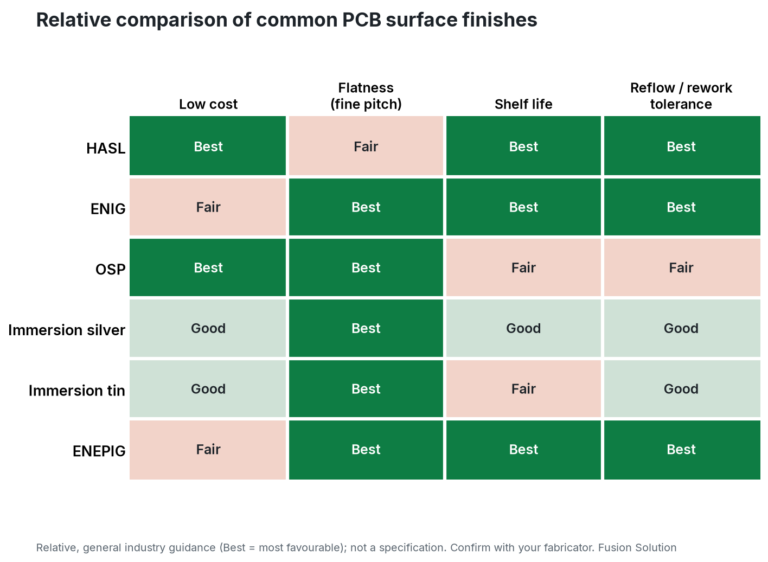
The chart above gives a relative comparison. The ratings are general industry guidance, not fixed specifications, so confirm details with your fabricator.
How to Choose the Right PCB Surface Finish
Start from the most demanding feature on the board and work outward:
- Fine-pitch or BGA parts. Choose a flat finish such as ENIG, OSP, immersion silver or immersion tin. Avoid standard HASL.
- Long storage before assembly. ENIG and HASL hold up best. OSP and immersion tin are better when boards are assembled soon after fabrication.
- Multiple reflow passes or rework. HASL and ENIG tolerate repeated heat better than OSP.
- Tight budget and simple parts. HASL or OSP keep cost down when pitch and storage allow.
- Wire bonding or mixed technology. ENEPIG covers soldering and bonding on one board.
- Harsh environments. Pair the finish with a protective layer such as PCB conformal coating after assembly.
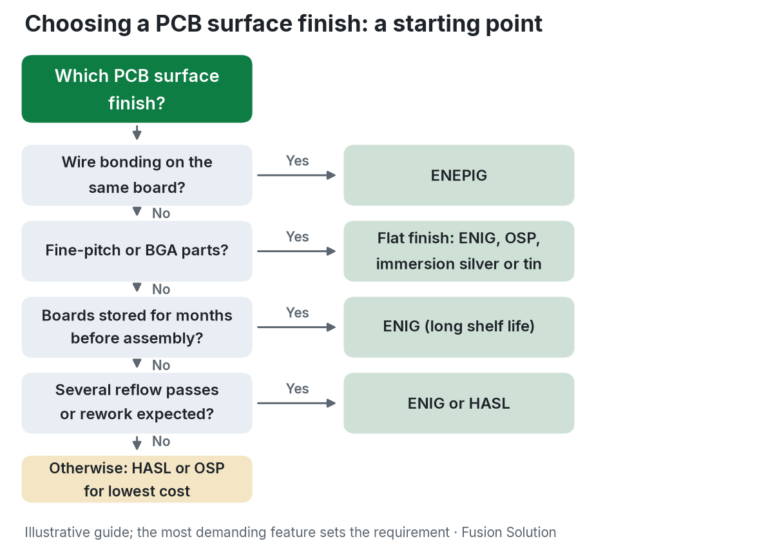
The decision guide above is a starting point, not a rule. A board with one BGA and many large passives may still be best served by ENIG, because the BGA sets the requirement.
Surface Finish, Stencils and Solder Paste
The finish interacts with the rest of the process. A flat finish lets the stencil seal well and deposit consistent paste volumes, which we cover in our posts on PCB stencil design and solder paste types. Reflow behaviour also depends on the finish, as discussed in perfecting the heat curve. Deciding all of these together avoids surprises at assembly.
Our PCB Surface Finish Approach at Fusion Solution
At Fusion Solution we ask about the finish early, during design review, rather than accepting a default on the fabrication notes. We look at the smallest pitch on the board, the assembly process, storage time and the operating environment, then recommend a finish that fits the product and the budget. That is part of the same thinking behind design for manufacturability, and it helps boards built in Calgary go through assembly cleanly the first time.
Ready to Choose the Right Finish?
If you are not sure which finish suits your next board, we can help before the fabrication order goes out. Talk to Fusion Solution about our PCB design and assembly services and we will help you match the finish to your design.