
Moisture, dust, salt and chemicals are some of the most common reasons electronics fail in the field. A board that works perfectly on the bench can corrode, leak current or short out after a few months on a wellsite, in a vehicle or in an unheated enclosure. PCB conformal coating is a thin protective film applied over the assembled board that shields it from these conditions. Here is what conformal coating is, which types are common, what must stay uncoated and how to plan for it in your design.
What Is PCB Conformal Coating?
Conformal coating is a thin polymer layer that follows the contours of the assembled board, covering components, solder joints and traces. It is not a thick potting compound. Typical films are measured in tens of microns, so they add very little weight and leave the board serviceable in most cases.
The coating acts as a barrier. It slows moisture and contamination from reaching bare metal, reduces the risk of leakage currents between closely spaced pins and helps protect against corrosion. It also gives some protection against dust, fungus and light chemical exposure, depending on the material.
Why Coat a Board at All?
- Humidity and condensation. Temperature swings in an unheated enclosure can cause condensation on the board. Coating keeps water from sitting directly on fine-pitch leads.
- Contamination. Dust, salt spray, oil mist and process chemicals can create conductive paths between pins.
- Corrosion. A sealed surface slows corrosion of leads, pads and exposed copper.
- Handling and vibration. Some coatings help hold light components in place and protect against minor abrasion, although they do not replace proper mechanical design.
- Reliability in harsh duty. Industrial, outdoor and downhole style electronics see conditions that a lab never does. We discuss this in our post on building reliable MWD electronics.
Common Types of Conformal Coating
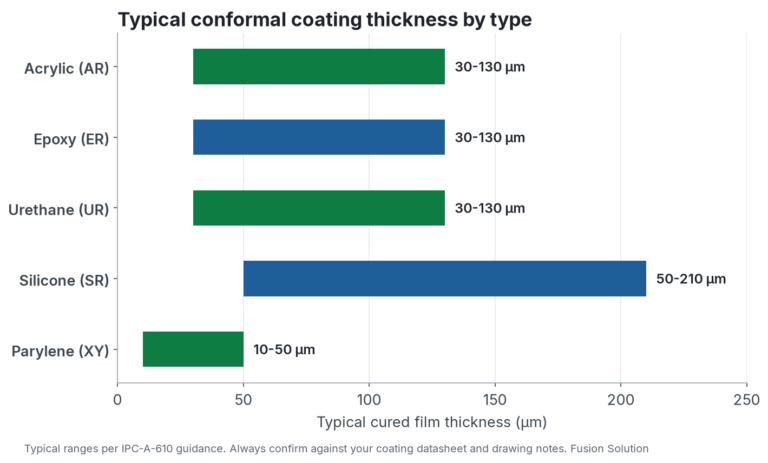
Coatings are grouped by chemistry. The IPC standard uses a short code for each family, and the right choice depends on the environment, how the board may need to be repaired and how the coating will be applied.
- Acrylic (AR). Easy to apply, easy to inspect and easy to remove or rework. A common general-purpose choice.
- Silicone (SR). Stays flexible across a wide temperature range and suits boards that see thermal cycling. It is usually applied thicker than other types.
- Urethane (UR). Good resistance to chemicals and solvents, but harder to rework.
- Epoxy (ER). A hard, durable film with strong chemical resistance. It is difficult to remove, so repair is limited.
- Parylene (XY). Applied from a vapour in a vacuum chamber as a very thin, even film. It reaches tight spaces but needs specialized equipment.
The chart above shows the typical cured thickness range for each family. Always confirm the figures against the datasheet of the specific product and the requirements on your drawing.
How Conformal Coating Is Applied
The method depends on the coating and on volume. Common options are brushing, dipping, spraying and selective automated dispensing. Brush and spray are common for prototypes and low volume work. Selective dispensing places the coating only where it is needed with good repeatability, which suits production. After application the film cures, either at room temperature, with heat or with UV light, depending on the chemistry. Inspection is often done under UV light because many coatings include a tracer that glows and shows coverage.
What Must Stay Uncoated
Not every part of a board should be coated. Coating on the wrong surface can ruin a connection or a mechanical part. Typical areas that are masked or kept clear include:
- Connectors and mating surfaces.
- Switches, potentiometers and other moving parts.
- Test points and programming headers that need to be accessed later.
- Heat sinks and thermal interface surfaces.
- Mounting holes and board edges used for grounding or enclosure contact.
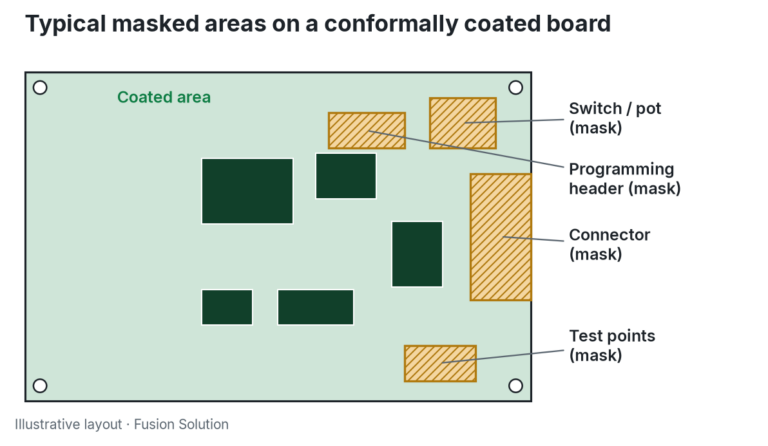
The diagram shows an illustrative board. Masking can be done with tape, peelable latex or dedicated fixtures, and each choice changes the cost and the cycle time.
Design Your Board for Conformal Coating
Coating goes much better when it is planned early. Good practice for PCB conformal coating includes:
- Keep connectors, switches and test points together along an edge or in one zone so masking is simple.
- Leave clearance around keep-out areas so coating does not creep onto them.
- Clean the board before coating. Flux residue and dirt trapped under the film can cause the very failures you are trying to prevent.
- Mark coated and uncoated areas clearly on the assembly drawing and state the coating type and thickness.
- Consider how the board will be repaired, since some coatings are far easier to remove than others.
These are the same habits that make a board easier to build in general, as covered in our post on design for manufacturability.
Our Conformal Coating Approach at Fusion Solution
At Fusion Solution we treat the operating environment as part of the design, not an afterthought. We start by asking where the product will live: how wet, how dirty, how hot and cold and how often it will be serviced. From there we help choose a coating, define the masked areas on the drawing and plan the process so that cleaning, coating and inspection fit smoothly into assembly in Calgary. That reduces surprises when boards go into the field.
Ready to Protect Your Electronics?
If your product has to survive moisture, dust or chemicals, coating is worth planning before the design is frozen. Talk to Fusion Solution about our PCB design and assembly services and we will help you decide what protection your board needs.