
Two boards can share the same layout, the same stencil and the same reflow oven, and still assemble very differently because of one decision: the solder paste types chosen for the build. On a board with 0.8 mm pitch parts almost any paste will do. Once you have 0.4 mm pitch QFNs, 0201 passives or 0.3 mm pitch CSPs, the powder size, alloy and flux in the jar decide whether you get clean joints or a rework bench full of bridges and opens. Here is how the main paste choices differ and how to match them to fine pitch parts.
What Is Solder Paste Made Of?
Solder paste is a suspension of tiny metal spheres in a flux medium. By weight it is roughly 88 to 90 percent metal, which works out to about half the volume. The flux cleans the surfaces, carries the powder through printing and keeps the paste tacky enough to hold components in place before reflow. Three choices define a paste: the powder size (its type number), the alloy and the flux chemistry.
Solder Paste Types by Powder Size
Under the IPC J-STD-005 standard, paste is graded by the size distribution of its powder. A higher type number means finer powder.
| Type | Particle size | Typical use |
|---|---|---|
| Type 3 | 25 to 45 µm | General SMT, 0.5 mm pitch and larger, 0402 and up |
| Type 4 | 20 to 38 µm | 0.4 mm pitch, 0201 passives, mixed fine and standard boards |
| Type 5 | 15 to 25 µm | 0.3 mm pitch CSPs, 01005 passives |
| Type 6 and finer | 5 to 15 µm (Type 6) | Micro-apertures, 008004 parts and specialty work |
The “typical use” column is common industry guidance, not a rule. Your stencil thickness, pad design and paste data sheet make the final call.
How to Choose Solder Paste for Small Pitch Parts
Start With the Aperture, Not the Part Number
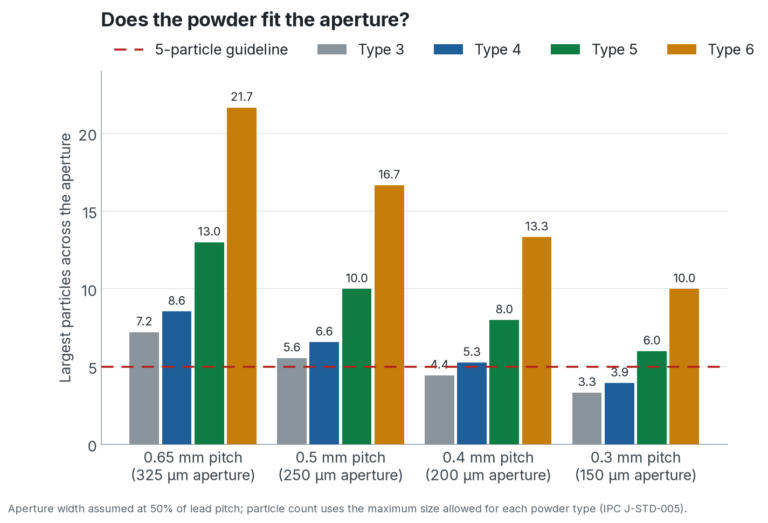
The usual rule of thumb is that at least five powder particles should fit across the narrowest stencil aperture, so the paste releases as a consistent deposit instead of a few clumps. The chart above shows why fine pitch forces a finer powder. With apertures at half the lead pitch, Type 3 manages only 4.4 particles across at 0.4 mm pitch. Type 4 just clears the guideline at 5.3, and at 0.3 mm pitch only Type 5 and finer pass. These figures use the maximum particle size allowed for each type, so real paste does a little better, but the trend holds.
Check Area Ratio and Aspect Ratio
Powder size works together with stencil design. As a general guideline, the area ratio of an aperture (opening area divided by wall area) should stay above about 0.66, and the aspect ratio (width divided by stencil thickness) above 1.5. Finer powder lets you use thinner foils and smaller openings while keeping good release. Our earlier post on PCB stencil design covers this in more detail.
The Trade-Offs of Finer Powder
Finer powder is not free. Moving up a type brings real effects on the line:
- Better print definition: smaller particles release cleanly from small apertures and give sharper deposits, which reduces opens and insufficient solder.
- More surface area, more oxide: fine powder has far more metal surface per gram, so it is more sensitive to oxidation. This can mean more voiding, graping and poor wetting if the paste is old or the profile is too long.
- Shorter working life: fine pastes can dry or stiffen faster on the stencil, so stencil life and humidity control matter more.
- Higher cost: finer powders cost more to make, so use them where the board needs them.
- Slump and bridging: a paste that is too thin or too hot in preheat can slump and bridge fine pitch pads, so the paste’s rheology matters as much as its type number.
A sensible default is the coarsest powder that clears the five-particle guideline on your smallest aperture with some margin.
Choosing the Alloy
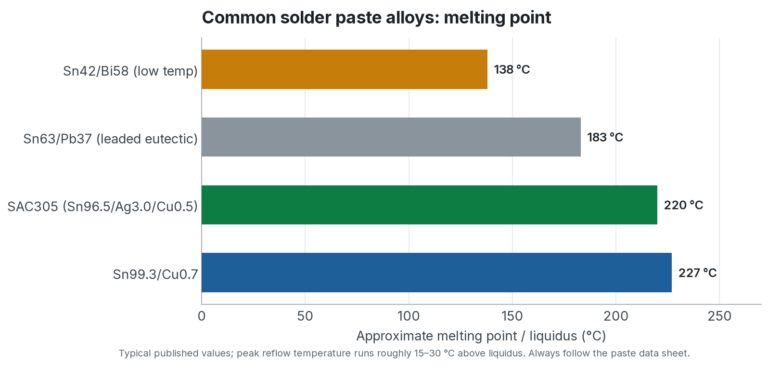
Alloy sets the reflow temperature and the mechanical behaviour of the joint. SAC305 (96.5% tin, 3.0% silver, 0.5% copper) is the most common lead-free choice and melts at about 217 to 220 °C. Leaded Sn63/Pb37 melts at 183 °C but is limited to exempt applications. Low-temperature tin-bismuth pastes melt near 138 °C and suit heat-sensitive parts, though bismuth alloys are more brittle. The alloy does not change print behaviour much, but it changes the whole reflow window, so it should be settled before the profile is built. See our post on perfecting the heat curve for how profile and alloy fit together.
Choosing the Flux
- No-clean: leaves a small, benign residue and is the usual choice for fine pitch boards because it avoids washing under tight-standoff parts.
- Water-soluble: very active and good at wetting, but residue must be washed off completely, which is hard under low-standoff components.
- Rosin-based: a traditional choice that generally needs cleaning on high-reliability products.
If the board will be probed in test, check that the residue of the chosen flux does not interfere with probe contact.
Storage and Handling Matter Too
Even the right paste fails if it is handled badly. Most manufacturers specify refrigerated storage, a warm-up to room temperature before the jar is opened (often several hours) and a limit on time on the stencil. Fine powder pastes are less forgiving of shortcuts, so follow the data sheet for your specific product.
Our Solder Paste Approach at Fusion Solution
We choose paste by looking at the finest pitch and smallest aperture on each board, then confirm the stencil thickness and aperture design in a DFM review before production. We match the reflow profile to the paste data sheet and keep handling consistent from jar to stencil. If your design includes 0.4 mm pitch parts or 0201 and smaller passives, send it to us early so paste and stencil are planned together in Calgary rather than discovered on the line.
Ready to Build Your Fine Pitch Board?
Whether you are prototyping a compact design or moving a small pitch board into production, the right paste is one of the cheapest ways to protect yield. Talk to Fusion Solution about our PCB assembly services and we will help you get it right the first time.